HomeDestinationGreeceKefalonia
Last updated: October 2026
Kefalonia holidays have a devoted following among UK travellers who prize natural beauty, authenticity and a destination that feels genuinely undiscovered — even though the island is well served by direct flights. This largest of the Ionian islands was catapulted to international fame by Louis de Bernieres’ novel Captain Corelli’s Mandolin and the subsequent film, but Kefalonia’s appeal goes far beyond literary associations. Myrtos Beach, the Melissani lake, Fiskardo village and the island’s exceptional local food and wine are all rewards that match any advance expectation.
Kefalonia suits couples, discerning travellers and those with a love of natural beauty and authentic Greek culture. It is not the cheapest or most packaged of the Greek islands — Kefalonia has deliberately avoided the mass-market resort development that transformed some of its neighbours — and that is a large part of its charm. Visitors tend to be more independent and curious, and the island rewards exactly those qualities with experiences that are genuinely memorable and distinct.
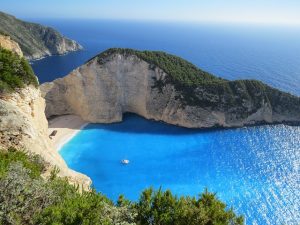
Myrtos Beach is widely considered the most beautiful and most photographed beach in all of Greece — a strong claim in a country of extraordinary beaches, but one that Myrtos consistently justifies. The beach is a crescent of brilliant white pebbles enclosed by steep green mountains that plunge dramatically into water of an intense, vivid turquoise that must be seen in person to be believed. The contrast of white stone, green mountain and turquoise sea is simply extraordinary.
Access to Myrtos is via a steep winding road that ends at a car park high above the beach, from which a path descends to the shore. The descent takes around 10 minutes on foot. Facilities on the beach are basic — a small snack bar and sun loungers for hire — but Myrtos is not a beach you visit for facilities. It is a beach you visit to experience one of the most spectacular natural settings in Greece. Arrive early in summer to secure a space; by mid-morning in July and August it is extremely busy.
The Melissani Cave and Lake near Sami on Kefalonia’s east coast is one of Greece’s most extraordinary natural wonders. The cave roof collapsed thousands of years ago, leaving a large central opening through which sunlight streams down into the underground lake below. When the sun is at the correct angle — typically mid-morning from April to October — the light refracts through the turquoise water to create an otherworldly blue glow that fills the cave with ethereal light.
Visitors are taken around the lake by boat, passing through both the open sunlit section and the darker enclosed section where stalactites hang from the cave ceiling. The experience lasts about 15 minutes but is entirely memorable. Nearby Drogarati Cave, also close to Sami, is a more conventional but equally impressive cave with impressive stalactites and stalagmites — the two caves make a natural pairing for a half-day excursion from any part of the island.
Argostoli, Kefalonia’s capital, is a lively, attractive town spread around a large bay in the island’s west. The town was almost entirely destroyed by the devastating 1953 earthquake and rebuilt in a clean, modernist style that gives it an unexpectedly cosmopolitan character. The long waterfront promenade — the Lithostroto — is lined with cafes, restaurants and shops, and is one of the most pleasant town centres in the Ionian islands for an evening stroll.
The Korgialenio History and Folklore Museum in Argostoli is excellent for understanding the island’s history, particularly the story of the 1953 earthquake and the rebuilding of Kefalonian communities. The Drapano Bridge crossing the lagoon to the Lassi peninsula is an attractive feature of the townscape, and the lagoon beneath it is home to loggerhead sea turtles that can often be seen from the bridge. The fish market along the quay is worth an early morning visit.
Fiskardo at the northern tip of Kefalonia is the only village on the island that survived the 1953 earthquake largely intact, preserving a cluster of original Venetian-era buildings around a pretty harbour that is unlike anywhere else on the island. The result is one of the most charming and photographed villages in the Ionian Sea — a crescent of colourful old buildings reflected in a marina filled with sleek yachts and traditional wooden kaïkis.
Fiskardo has developed a reputation as a destination for yacht charterers and upmarket visitors, with excellent seafood restaurants, boutique guesthouses and a sophisticated atmosphere that belies its small size. A leisurely lunch at a waterfront restaurant here is one of the great pleasures of a Kefalonia holiday. The road from Argostoli north to Fiskardo passes through some of the island’s most beautiful mountain and coastal scenery.
Lassi, the peninsula immediately west of Argostoli, is Kefalonia’s main resort area — a strip of hotels, apartments, restaurants and bars accessed via the Drapano Bridge from the capital. The beaches at Makris Gialos and Platis Gialos on the Lassi peninsula are sandy and well-equipped, with watersports, beach bars and sun lounger hire. The proximity to Argostoli makes Lassi an excellent base for those who want resort facilities alongside easy access to the capital.
The sunsets from the Lassi area, looking out over the bay and Argostoli lighthouse, are particularly beautiful. The area has a good concentration of tavernas and restaurants at all price levels, from simple grills to more sophisticated establishments serving the full range of Kefalonian cuisine. For families or first-time visitors to Kefalonia, Lassi provides a comfortable and well-serviced introduction to the island.
Sami on the east coast is Kefalonia’s main ferry port, receiving boats from Patras on the mainland and from Ithaca. The town has a pleasant waterfront, good tavernas and is the base for visits to Melissani Lake and Drogarati Cave. The small resort of Agia Effimia, just north of Sami, has a charming harbour, crystal-clear water for snorkelling and a relaxed atmosphere popular with yacht crews and independent travellers.
The coastline between Sami and Agia Effimia is among the most dramatic on Kefalonia, with the mountains of the island’s spine rising steeply from the shore. The road along this stretch offers extraordinary views across the strait towards Ithaca, the island forever associated with Homer’s Odysseus. Day trips to Ithaca by ferry from Sami or Agia Effimia are straightforward and give a wonderful contrast to the relative bustle of Kefalonia.
Louis de Bernieres’ novel Captain Corelli’s Mandolin brought Kefalonia to the attention of a generation of British readers, and the island’s Italian and Greek wartime history remains a powerful part of its identity. The story — centred on the Italian occupation of the island during World War Two and the subsequent massacre of Italian soldiers by German forces in 1943 — is rooted in real historical events that left a deep mark on Kefalonia.
The village of Assos, with its magnificent clifftop Venetian fortress, closely resembles locations described in the book and used in the film. Antisamos beach — used for the film’s swimming scenes — is a beautiful white pebble bay accessible from Sami. Visiting these locations gives the novel and film an extraordinary reality and adds a poignant historical dimension to what would already be a beautiful destination.
Kefalonia International Airport Anna Pollatou (EFL) receives direct charter and scheduled flights from UK airports, with a flight time of approximately 3.5 hours from London. Direct flights operate from Heathrow, Gatwick, Manchester, Birmingham and other UK regional airports during the summer season, typically from May to October. The airport is close to Argostoli.
Taxis and hire cars are available from the airport. Car hire is highly recommended on Kefalonia — the island is large and hilly, and the best beaches and sights require independent transport. A hire car allows you to take Myrtos Beach, Fiskardo and the cave lakes in your own time and at your own pace. For peace of mind when booking, always check your holiday is ABTA protected.
Few islands reward independent, curious travellers quite so generously.
It is, simply, an easy island to fall for.
| Airport | Kefalonia International Anna Pollatou (EFL) |
| Main resorts | Lassi, Argostoli, Sami, Agia Effimia, Fiskardo, Skala, Lourdata |
| Highlight | Myrtos Beach – Greece’s most photographed beach |
| Best for | Couples, discerning travellers, natural beauty, culture |
| Climate | Hot summers, green and sometimes wet winters, lush Ionian landscape |
| Flight time from London | Approximately 3.5 hours |
| Currency | Euro (EUR) |
| Language | Greek |
Search4Sun compares thousands of Kefalonia holiday deals from the UK’s leading tour operators, with departures from local airports across the UK. For peace of mind when booking, always check your holiday is ABTA protected.
For last-minute Kefalonia deals, check LastMinute.com for the latest availability and rates.
Kefalonia is one of the best Greek islands for couples, offering natural beauty, romantic settings and a sophisticated atmosphere that tends to attract a more discerning clientele than the busier package holiday islands. Fiskardo harbour at evening, a private boat to Myrtos, dinner in Argostoli — the island delivers romance at every turn.
Boutique hotels and private villa rentals are particularly well developed on Kefalonia, offering couples more intimate and stylish accommodation options than a standard resort hotel. The island’s wine scene — particularly the Robola white wine produced in the mountains above Argostoli — adds another dimension to the pleasures of a Kefalonian evening.
Robola is Kefalonia’s indigenous white grape variety and the island’s most celebrated wine. Grown on steep limestone slopes in the Omala valley above Argostoli, Robola produces a dry, crisp, mineral white wine with distinctive citrus and almond notes. It is recognised with a PDO (Protected Designation of Origin) designation and is among the most interesting native Greek grape varieties.
The Robola Cooperative winery in Fragkato is open to visitors and offers tours and tastings. Visiting the winery and the mountain scenery of the wine-producing zone is an excellent half-day excursion from the main resort areas. Robola pairs beautifully with fresh seafood, grilled fish and local cheeses — all readily available in Kefalonian tavernas.
Myrtos Beach is on Kefalonia’s north-west coast, roughly 30 km north of Argostoli. The most practical way to reach it is by hire car — there is a car park above the beach from which a path descends to the shore in about 10 minutes. Some tour operators run organised excursions to Myrtos, and taxis can be hired for the day from Argostoli or Lassi.
There is no direct public bus service to Myrtos. The scenic coastal road north towards Myrtos passes through beautiful mountain landscape and small villages, making the drive itself worthwhile. The view of Myrtos from the roadside viewpoint about 1 km before the main car park is one of the most dramatic in Greece — pull over safely and take in the panorama before descending to the beach.
June and September are arguably the finest months for a Kefalonia holiday. June brings warm, settled weather with the island at its greenest before the summer heat browns the vegetation. September sees the tourist numbers fall, temperatures remain ideal for swimming, and tavernas are still fully open with the season’s best produce available.
July and August are peak season and the most expensive period, but also when the island’s beaches and social life are at their most vibrant. October is quieter and cooler but still pleasant for walking and sightseeing. The island begins closing down for winter in November, with many businesses shut from December to March.
For those considering a multi-centre trip or planning a future visit, Zante, Skiathos and Santorini are among the other Greek destinations worth exploring.

Visa requirements vary significantly by nationality. We recommend contacting your local embassy or immigration office for accurate and up-to-date information.
Check requirements at IATA Travel Centre →| Month | Avg Temp (°C) | Avg Rainfall (mm) |
|---|---|---|
| Jan | 8.2°C | 151.2 mm |
| Feb | 8°C | 69.7 mm |
| Mar | 9.5°C | 74.8 mm |
| Apr | 12.9°C | 50.5 mm |
| May | 17.6°C | 68.8 mm |
| Jun | 24°C | 26 mm |
| Jul | 27.2°C | 4.7 mm |
| Aug | 25.7°C | 18.3 mm |
| Sep | 21°C | 66.3 mm |
| Oct | 16.5°C | 103.9 mm |
| Nov | 13.1°C | 208.2 mm |
| Dec | 9.4°C | 134.3 mm |
Search4Sun has been comparing UK holiday packages since 2005. We work with some of the best ABTA-registered operators.