Last updated: October 2026
Norway holidays deliver the most dramatic natural scenery in Europe — a country where glacier-carved fjords plunge over a kilometre deep between cliff walls that rise sheer from the water to snow-capped summits, where the Northern Lights paint the Arctic sky in curtains of green and violet, and where the midnight sun illuminates mountain peaks at 2am in midsummer. Norway is a destination of superlatives: the longest fjord, the deepest fjord, the most scenic railway journey, the most dramatic coastal archipelago.
For UK travellers, Norway is accessible within 2 hours from London and offers experiences that are genuinely impossible to replicate anywhere else in Europe. This guide covers everything you need to plan an unforgettable Norway holiday.
Norway consistently ranks as one of the world’s most desirable travel destinations, and the reasons are obvious the moment you arrive: the scale and drama of the natural landscape is simply without equal in Europe. The fjords alone — UNESCO World Heritage listed since 2005 — are one of the great natural wonders of the world, but they exist alongside an Arctic coast of extraordinary beauty, a highland interior of glaciers and national parks, and cities of genuine cultural depth.
Norway also offers remarkable seasonal contrast. In summer (June–August), the midnight sun keeps the landscape illuminated through the night above the Arctic Circle, creating a dreamlike quality to outdoor activities and fjord cruises. In winter (September–March), the darkness above the Arctic Circle creates the perfect conditions for Northern Lights viewing, and the snow transforms the landscape into a pristine white wilderness perfect for skiing, dog sledding and snowshoeing.
The country is expensive by European standards — Norway consistently ranks as one of the world’s most costly destinations for visitors — but the quality of experience is commensurate. UK tour operators offer well-structured packages that control costs effectively, and the memories created in Norway’s extraordinary landscapes are difficult to put a price on.
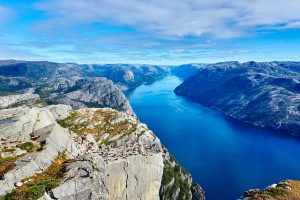
The Norwegian fjords are the defining natural attraction of Scandinavia and one of the most spectacular landscapes on earth. Formed by glaciers over millions of years, these deep sea inlets cut far into the Norwegian mountain interior, creating waterways of extraordinary depth flanked by cliff walls that often rise sheer for hundreds of metres. The combination of calm water reflecting the surrounding peaks, waterfalls dropping directly from the cliffs above, and the scale of the landscape — dwarfing any boat or building placed within it — creates an overwhelming sense of natural grandeur.
The Sognefjord, at 205 kilometres long and 1,308 metres deep, is the longest and deepest in the world. The Aurlandsfjord and Nærøyfjord — branches of the Sognefjord that are UNESCO World Heritage listed — are the most scenically dramatic sections, where the fjord narrows to just 250 metres wide with cliff walls rising 1,700 metres on both sides. The village of Flåm at the head of the Aurlandsfjord is the departure point for the famous Flåmsbana railway — one of the steepest standard-gauge railway lines in the world — which climbs 865 metres through 20 tunnels and past waterfalls in a journey of extraordinary beauty.
The Geirangerfjord is the most photographed fjord in Norway — a UNESCO World Heritage Site where the “Seven Sisters” waterfall plunges in multiple streams directly from the cliff face into the water below, and where abandoned mountain farms cling impossibly to the cliff sides above. Cruise ships and tourist ferries make regular journeys through the fjord in summer, but the most dramatic perspectives are from the viewpoints above — the Eagle Road and the Geiranger-Trollstigen mountain pass, one of Norway’s most scenic drives.
Bergen is Norway’s second city and the traditional gateway to the fjord country — a compact, characterful harbour city surrounded by seven mountains, with a historic wharf district that has been at the heart of Norwegian trade for over 800 years. The Bryggen — a row of coloured wooden medieval buildings lining the north side of the harbour — is a UNESCO World Heritage Site and one of the most photographed urban scenes in Scandinavia.
Bergen is small enough to explore on foot in a single day but rewarding enough to justify a stay of 2–3 nights. The Fløibanen funicular rises from the city centre to the top of Mount Fløyen in 8 minutes, providing panoramic views across the harbour, the surrounding mountains and the fjords beyond. The fish market (Fisketorget) on the harbour front has been selling fresh seafood to Bergen residents and visitors since the 15th century. The Edvard Grieg Museum at Troldhaugen, the composer’s lakeside home 8 kilometres south of the city, is a beautifully preserved memorial to Norway’s greatest composer.
Bergen is also the starting point for the celebrated “Norway in a Nutshell” tour — a combination of train, fjord ferry and bus that takes in the Flåmsbana railway, the Nærøyfjord and the Myrdal mountain crossing in a single day journey between Bergen and Oslo. This remains one of the finest scenic journeys in the world and is the ideal introduction to the Norwegian fjord landscape for first-time visitors.
Tromsø, 350 kilometres above the Arctic Circle on Norway’s northern coast, is the premier Northern Lights destination in Norway and one of the finest in the world. The city of 77,000 people — the largest urban centre in the Norwegian Arctic — combines excellent tourist infrastructure with a location well above the auroral oval, giving it statistically more frequent sightings than many more remote locations. The surrounding landscape of fjords, mountains and island archipelagos provides dramatic foreground scenery for aurora photography.
The Northern Lights are visible from Tromsø from late September to late March, with the peak viewing period from November to February when nights are longest and the magnetic conditions most favourable. The Tromsø region offers an exceptional range of aurora-chasing activities: snowmobile safaris into the mountains and valleys away from the city lights; dog sled expeditions by night; guided snowshoe hikes; and evening cruises by boat where the open water provides unobstructed sky views in all directions.
Tromsø itself is an engaging and lively city even outside the aurora season. The Arctic Cathedral (Ishavskatedralen) — its distinctive triangular aluminium facade visible from across the fjord — is one of Norway’s most striking modern buildings. The Tromsø University Museum has excellent exhibits on the Sami people and Arctic culture. The city’s bar and restaurant scene is surprisingly vibrant for a city of its size and latitude, and the après-Northern Lights atmosphere in the central bars is warm and convivial.
The Lofoten Islands are one of Norway’s most spectacular and most visited natural destinations — a chain of islands extending into the Norwegian Sea off the northern coast, where dramatic mountain peaks rise directly from the water and traditional red and yellow fishermen’s cottages (rorbu) dot the shoreline of every bay. The combination of the islands’ raw mountain scenery, the quality of the fishing and outdoor activities available, and the extraordinary light — both the midnight sun in summer and the Northern Lights in winter — makes Lofoten one of Scandinavia’s most photogenic destinations.
The main villages of Svolvær, Henningsvær, Stamsund and Å (the village whose name consists of a single letter — one of the shortest place names in the world) each have distinctive character and excellent accommodation in converted fishermen’s cottages. The islands are connected by tunnels and bridges and can be explored by hire car, bicycle or on foot. The hiking is outstanding: trails to dramatic viewpoints such as Ryten mountain above Kvalvika beach, and the “King” and “Queen” peaks above Svolvær, are among the finest coastal walks in Norway.
Lofoten is accessible by daily flights from Oslo to Svolvær and Leknes airports, or by overnight ferry from Bodø. The ferry from Bodø to Moskenes, at the southern tip of the island chain, takes 3 hours 30 minutes and provides spectacular scenery on arrival. Many visitors combine a visit to Lofoten with Tromsø for a comprehensive northern Norway experience.
Oslo Gardermoen Airport (OSL) is the main international gateway, with direct flights from UK airports including London Heathrow, Gatwick, Manchester and Edinburgh operated by SAS, Norwegian Air, British Airways and easyJet. Flight time from London is approximately 2 hours. Bergen Airport (BGO) is served by direct flights from London and several UK regional airports. Tromsø Airport (TOS) receives seasonal direct flights from UK airports, primarily during the winter Northern Lights season.
Internal travel in Norway is excellent. The Bergen Railway between Oslo and Bergen (5 hours 30 minutes) is one of the world’s great scenic train journeys. The coastal ferry service (Hurtigruten) connects Bergen to Kirkenes via 34 ports along the Norwegian coast — a famous voyage that takes 12 days for the full round trip but can be joined and left at individual ports. Car hire in Norway is practical but expensive — the scenic mountain roads and fjord driving routes are among the finest in Europe.
Search4Sun works with leading UK tour operators to find the best value Norway holidays. Browse departures from local airports across the UK. For peace of mind when booking, always check your holiday is ABTA protected.
For last-minute deals, check LastMinute.com for the latest availability and rates.
The “Norway in a Nutshell” tour — combining the Bergen Railway, the Flåmsbana mountain railway and a fjord ferry through the Nærøyfjord — is the most popular and most convenient way to experience the fjords on a tight schedule. It can be done as a day excursion from Bergen or Oslo or as an overnight journey between the two cities. The route takes in the finest scenery in the Sognefjord region.
For a more immersive experience, a self-drive tour through the fjord region over 5–7 days — combining the Geirangerfjord, the Sognefjord and the fjord villages of Flåm, Gudvangen and Balestrand — allows for hiking, photography and the slower appreciation of the landscape that a day tour cannot provide. Hire cars are available at Bergen and Oslo airports.
The Northern Lights are visible in Arctic Norway from late September to late March when nights are sufficiently dark. The peak months are November, December, January and February. Tromsø, Alta and the Lofoten Islands are the most popular Northern Lights destinations in Norway. Clear skies are essential — the Norwegian Arctic coast is frequently cloudy, so a stay of at least 4–5 nights maximises the chance of a sighting.
Aurora forecasting apps (such as My Aurora Forecast) give 1–3 day predictions of solar activity and help identify the best nights to venture out. Most Tromsø tour operators offer “guarantee” programmes where the excursion fee is refunded if the lights are not seen, though the terms vary between operators. Photographing the aurora requires a DSLR or mirrorless camera with manual settings — smartphone cameras generally struggle with low-light aurora photography.
Oslo is an excellent city break destination with a remarkable concentration of world-class museums — the National Museum (housing Munch’s The Scream), the Viking Ship Museum, the Fram Museum and the Kon-Tiki Museum are all within easy reach of each other. The Aker Brygge and Tjøuvholmen waterfront districts have transformed the city’s feel in the past decade, and the Munch Museum (completed 2021) is one of northern Europe’s finest new gallery buildings.
Bergen is the better city break option for those primarily interested in using the city as a base for fjord excursions — the Flåmsbana railway, Nærøyfjord ferry and Hardangerfjord are all accessible as day trips. Both cities have excellent restaurant scenes, though at prices that reflect Norway’s high cost of living.
Norway is consistently one of the most expensive destinations in the world for visitors. Restaurant meals, accommodation, alcohol and transport all cost significantly more than in comparable European destinations — a main course in a mid-range Oslo restaurant typically costs £25–40, and a pint of beer around £10–12. However, quality is high and the experience justifies the expenditure for most visitors.
Costs can be managed by self-catering where possible, using supermarkets for lunch and snacks, booking accommodation well in advance, and using the Oslo Pass or Bergen Card which include public transport and museum entry. Package holidays booked through UK operators often represent better value than booking flights and accommodation separately, as operators have volume rates with Norwegian hotels.
If you book a flight-inclusive Norway package through a UK ATOL-licensed tour operator, yes — your money and return flights are protected if the operator fails. Booking independently removes ATOL protection entirely. See our holiday protection guide for the full breakdown on ATOL, ABTA and Section 75.
All packages listed on Search4Sun are offered by ATOL-licensed UK tour operators, so you can compare and book with complete confidence.
Most popular full-day tours


Visa requirements vary significantly by nationality. We recommend contacting your local embassy or immigration office for accurate and up-to-date information.
Check requirements at IATA Travel Centre →| Month | Avg Temp (°C) | Avg Rainfall (mm) |
|---|---|---|
| Jan | -6.9°C | 62.7 mm |
| Feb | -5.5°C | 47.6 mm |
| Mar | -2.5°C | 52.4 mm |
| Apr | 0.9°C | 40.6 mm |
| May | 7°C | 46.9 mm |
| Jun | 12.1°C | 78.2 mm |
| Jul | 13.7°C | 117.3 mm |
| Aug | 11.9°C | 103.5 mm |
| Sep | 9°C | 93 mm |
| Oct | 3.7°C | 78.6 mm |
| Nov | -1.3°C | 63.4 mm |
| Dec | -5.2°C | 54.5 mm |
Search4Sun has been comparing UK holiday packages since 2005. We work with some of the best ABTA-registered operators.