HomeDestinationScandinaviaDenmark
Last updated: October 2026
Denmark holidays deliver one of Europe’s most rewarding short-break destinations — a country where the world’s most celebrated food capital sits alongside Viking ring fortresses, fairy-tale Renaissance castles and the original LEGOLAND, all within two hours’ flying time of the UK. The smallest of the Scandinavian countries, Denmark packs an extraordinary range of experiences into a compact and easily navigable landscape, and its famously warm and informal population makes UK visitors feel immediately at home.
Whether you are drawn to the harbour-front restaurants and design culture of Copenhagen holidays, the Viking Age monuments of Jutland, or the cycling paradise of the Danish countryside, this guide covers everything you need to plan the perfect Denmark holiday.
Denmark occupies a unique position in European travel: it is close enough for a long weekend, sophisticated enough for the most discerning traveller, and genuinely different enough from the UK to feel like a proper foreign adventure. The Danish concept of “hygge” — a word meaning cosy, convivial contentment that has no direct English equivalent — permeates the culture in a way that makes Denmark feel immediately welcoming, with its warm candlelit cafés, unpretentious restaurants and unhurried pace of life.
The country consistently tops global rankings for happiness, quality of life and work-life balance, and these qualities translate into a relaxed and pleasant holiday atmosphere. Copenhagen is one of the world’s most liveable cities and one of its most exciting food destinations; the Danish countryside is ideal cycling territory with well-maintained cycle paths connecting towns, beaches and historical sites; and the heritage — from Bronze Age burial mounds to Viking ring fortresses to the castles that inspired Hans Christian Andersen — gives every visit unexpected depth.
Denmark is also extremely family-friendly. LEGOLAND in Billund, located in the geographic centre of Jutland, is one of the original theme parks and remains one of the finest family destinations in northern Europe. Danish beaches — particularly on the west coast of Jutland and on the island of Bornholm — are wide, clean and often uncrowded. English is spoken universally and the country’s compact size makes it easy to combine multiple destinations in a single trip.
Copenhagen holidays centre on one of Europe’s most stylish and most enjoyable capital cities — a compact, cycling-friendly city where Michelin-starred restaurants sit alongside colourful harbour-front townhouses, world-class design shops and one of the oldest amusement parks in the world. The city has undergone a remarkable transformation over the past two decades, repositioning itself from a pleasant but unremarkable Scandinavian capital into a globally recognised destination for food, design and urban culture.
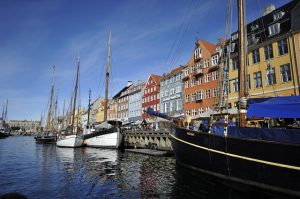
Nyhavn — the 17th-century harbour canal lined with colourful Dutch-style townhouses and waterfront restaurants — is the iconic image of Copenhagen and the city’s most popular gathering point. The canal is lined with cafes and restaurants that spill onto outdoor terraces throughout the summer, and the mixture of working boats, tourist ferries and the coloured reflections in the still water creates one of the most photographed urban scenes in Scandinavia. Hans Christian Andersen lived at number 20 for a period — a fact marked with a small plaque on the building.
The neighbourhood of Christiania — a self-declared “free state” established by squatters in 1971 in a former military area — is one of Copenhagen’s most distinctive and most visited areas. It functions as an alternative community with its own rules and culture, with craft workshops, music venues, vegetarian restaurants and a relaxed atmosphere that is genuinely unlike anywhere else in Denmark. Visiting Christiania is a fascinating and thought-provoking experience regardless of one’s views on its politics.
Denmark has become one of the world’s most important food destinations since the early 2000s, when Copenhagen restaurants began reimagining Scandinavian cuisine using strictly local and seasonal ingredients. The movement — dubbed “New Nordic” — produced Noma, which held the title of World’s Best Restaurant four times and influenced a generation of chefs across the globe. While Noma has since closed its restaurant doors, the culinary legacy it created in Copenhagen remains extraordinary.
Copenhagen now has more Michelin stars per capita than almost any other city in Europe, and the quality of dining extends well beyond the fine dining tier. The city’s food markets — particularly Torvehallerne, a covered market hall near Nørreport station — sell outstanding produce, street food and artisan products. The smørrebrød — the traditional Danish open sandwich of rye bread topped with cured fish, meat and various garnishes — is one of the world’s great lunchtime traditions and best experienced at a dedicated smørrebrød restaurant in central Copenhagen.
Beyond Copenhagen, Danish food culture extends to a strong tradition of local bakeries (bageri) producing exceptional sourdough bread, pastries and the world-famous Danish pastry (wienerbrød), which bears no resemblance to the supermarket versions sold in the UK. A morning visit to a good Danish bakery — a bag of freshly baked pastries and a proper coffee — is one of the simplest and most pleasurable rituals of a Denmark holiday.
Denmark has a remarkable density of castles, manor houses and historical monuments for a relatively small country. Kronborg Castle at Hels ingør, north of Copenhagen, is one of the most important Renaissance fortresses in northern Europe — built by King Frederick II in the 1580s and familiar worldwide as the setting for Shakespeare’s Hamlet. The castle guards the narrow strait between Denmark and Sweden and its strategic position is as obvious today as it was 400 years ago. The interior contains impressive tapestries, a vast ballroom and the legendary underground halls where the statue of the sleeping Holger Danske waits to wake and defend Denmark in its hour of need.
Frederiksborg Castle at Hillerød, also north of Copenhagen, is the most magnificent Renaissance building in Scandinavia — a palace of extraordinary grandeur set on islands in a lake, its copper spires and Dutch Renaissance facades reflected in the still water. The castle now houses the Museum of National History with an outstanding collection of Danish portraits and historical paintings. Rosenborg Castle in central Copenhagen, a smaller 17th-century royal pleasure palace, houses the Danish Crown Jewels in its basement treasury — one of the finest collections of royal regalia in Europe.
The Viking heritage of Denmark is explored most comprehensively at the National Museum in Copenhagen (the Viking collection is one of the finest in the world) and at the Trelleborg ring fortress near Slagelse on Zealand — one of five perfectly circular Viking military camps built by Harald Bluetooth around 980 AD, whose geometric precision still astonishes modern visitors. The Lejre Museum near Roskilde recreates an Iron Age and Viking Age village with costumed guides and working craft demonstrations.
Jutland — the large peninsula that forms the mainland of Denmark, connected to Germany in the south — is a landscape of heath, dunes, ancient forests and fishing villages that provides a very different experience to the urban culture of Copenhagen. The west coast of Jutland has some of the finest beaches in northern Europe: long stretches of white sand backed by dunes, with the cold North Sea breaking in steady Atlantic rollers. Skagen, at the very tip of Jutland where the North Sea and Baltic Sea visibly meet, is one of Denmark’s most atmospheric towns — beloved by Danish artists in the 19th century for its extraordinary light and still home to an excellent art museum.
LEGOLAND in Billund, in the heart of Jutland, is one of the original and finest theme parks in Europe — a full-day experience built around miniature LEGO recreations of world cities, rides, shows and interactive experiences that genuinely engages children from 3 to 12. The park is adjacent to the LEGO House — a newer attraction designed by Bjarke Ingels that explores the history and creativity of LEGO in an architecturally remarkable building — giving Billund a full two-day programme for families.
The Danish islands beyond Zealand — Funen, Bornholm, Møn and Æ rø — each have distinct characters worth exploring. Bornholm, in the Baltic Sea, is the most distant and most distinctive: a rocky granite island with a completely different geology from the rest of Denmark, outstanding smoked herring (røgeri), round medieval churches found nowhere else in Denmark, and a slow, cycling-friendly pace of life that makes it the favourite Danish holiday island for many locals.
Copenhagen Airport (CPH) at Kastrup is one of the best-connected airports in Scandinavia, with direct flights from UK airports including London Heathrow, Gatwick, Manchester, Edinburgh, Birmingham and Bristol. Flight time from London is approximately 2 hours. SAS, British Airways, easyJet and Norwegian all serve the route with multiple daily departures. Billund Airport (BLL) in Jutland is served by direct Ryanair flights from UK airports, making LEGOLAND holidays straightforward without a connection through Copenhagen.
Copenhagen Airport is directly connected to the city centre by metro in 15 minutes — one of the most convenient airport-to-city connections in Europe. The city’s cycling infrastructure is world-class, with dedicated cycle lanes on virtually every street and excellent public hire bikes available from numerous points across the city. Car hire is available for exploring Jutland and the rural areas of Zealand.
| Main Airports | Copenhagen (CPH), Billund (BLL), Aarhus (AAR) |
|---|---|
| Main Destinations | Copenhagen, Jutland, LEGOLAND Billund, Bornholm |
| Highlight | Copenhagen food scene and Kronborg Castle (Hamlet’s castle) |
| Best For | City breaks, food, families, history, cycling |
| Climate | Mild summers (20–22°C); cold winters; rain possible year-round |
| Flight Time from London | Approximately 2 hours |
| Currency | Danish Krone (DKK) |
| Language | Danish (English universally spoken) |
Look for ABTA membership, ATOL protection or ABTOT cover — these schemes protect your money if an operator ceases trading before or during your holiday. For a plain-English guide to what each scheme covers, read our holiday protection guide.
For last-minute deals, check LastMinute.com for the latest availability and rates.
May, June and September are the best months for Denmark holidays. The weather is warm and pleasant (18–22°C), the days are long and Copenhagen’s outdoor café and restaurant terraces are at their most enjoyable. June in particular is excellent — the days are very long, the city is vibrant and the countryside is at its greenest.
July and August are peak season with higher prices and more visitors, particularly in Copenhagen. December is a wonderful time to visit for the Christmas markets, which are among the finest in northern Europe — Tivoli Gardens in particular is transformed into a magical winter wonderland with thousands of lights, ice skating and seasonal food stalls. Winter temperatures are cold but manageable (2–7°C).
Denmark is outstanding for families. LEGOLAND in Billund is one of the best family theme parks in Europe and a strong enough reason alone to plan a Danish family holiday. Tivoli Gardens in Copenhagen — the world’s second-oldest amusement park, opened in 1843 — is a magical experience for children of all ages, combining traditional fairground rides with gardens, restaurants and live entertainment in a beautifully maintained setting.
The Danish beach destinations on Jutland’s west coast and the island of Bornholm are excellent for families in summer. Danish food is child-friendly, English is spoken everywhere, and the country’s well-maintained cycling infrastructure makes family cycling holidays particularly enjoyable and safe. Many Danish campsites and holiday parks are specifically geared to families.
In Copenhagen, a car is completely unnecessary — the city’s metro, bus network, cycling infrastructure and walkability make getting around very easy without one. For exploring Zealand (the island on which Copenhagen sits), a car is useful but not essential given good train connections to Hels ingør (Kronborg Castle) and Hillerød (Frederiksborg Castle).
For exploring Jutland, the Danish islands and the countryside, a hire car is strongly recommended. The Danish road network is excellent, driving is on the right and traffic outside Copenhagen is generally light. Alternatively, Denmark’s inter-city train and bus network connects the major towns efficiently.
Hygge (pronounced roughly “hoo-gah”) is the Danish concept of cosy, convivial contentment — the feeling of warmth and well-being that comes from good company, candlelight, comfort food and a sense of being sheltered from the outside world. It is an attitude as much as an activity, and it permeates Danish life at every level from home entertaining to café culture.
You will definitely experience hygge in Denmark, almost immediately. The Danish café culture — all candles, rough wooden furniture and excellent coffee — is the most obvious expression of it, but it extends to the warmth of welcome in Danish restaurants, the unhurried pace of evenings out, and the general sense that Danes have consciously prioritised enjoyment and human connection over productivity and rushing. It is one of the most charming and distinctive aspects of Danish culture for UK visitors.
If you book a flight-inclusive Denmark package through a UK tour operator holding an ATOL licence, your money is fully protected if the company fails before or during your trip. Booking flights and accommodation separately removes this protection. Our holiday protection guide explains ATOL, ABTA and Section 75 of the Consumer Credit Act in plain English.
All packages listed on Search4Sun are offered by ATOL-licensed UK tour operators, so you can compare and book with complete confidence.
Most popular full-day tours


Visa requirements vary significantly by nationality. We recommend contacting your local embassy or immigration office for accurate and up-to-date information.
Check requirements at IATA Travel Centre →| Month | Avg Temp (°C) | Avg Rainfall (mm) |
|---|---|---|
| Jan | 2.1°C | 85.8 mm |
| Feb | 2.7°C | 55.8 mm |
| Mar | 4.2°C | 44.5 mm |
| Apr | 6.9°C | 61.7 mm |
| May | 11.5°C | 71.3 mm |
| Jun | 15.1°C | 71.7 mm |
| Jul | 16.6°C | 111.2 mm |
| Aug | 16.2°C | 69.7 mm |
| Sep | 14.2°C | 75.6 mm |
| Oct | 10.3°C | 90.1 mm |
| Nov | 5.7°C | 51.6 mm |
| Dec | 3°C | 75.7 mm |
Search4Sun has been comparing UK holiday packages since 2005. We work with some of the best ABTA-registered operators.