HomeDestinationCaribbeanGrenada
Last updated: October 2026
Grenada holidays offer one of the most unspoiled and naturally beautiful experiences in the Caribbean — an island where the scent of nutmeg, cinnamon and cloves drifts from the plantations that gave Grenada its nickname, the Spice Island, and where Grand Anse beach is consistently rated among the ten finest in the world. Grenada sits at the southern end of the Windward Islands, below the hurricane belt, and its relatively undeveloped character gives it an authenticity that more resort-heavy islands have lost.
This guide covers everything you need to plan and book a Grenada holiday from the UK — Grand Anse beach, the spice plantations, the underwater sculpture park, chocolate making and all the practical travel information.
Grenada holidays attract visitors who want a Caribbean experience of genuine natural beauty and authentic island life — a destination that has not been over-developed, where the beaches are stunning but not wall-to-wall resort hotels, where local food and culture are accessible and vibrant, and where the landscape of rainforest, waterfall and volcanic peak adds a dimension beyond the purely coastal that most Caribbean islands cannot match.
The island is compact — about 21 by 12 miles — but packs in extraordinary variety. The lush interior, watered by the Atlantic trade winds, supports rainforest, spice plantations, a lake in a volcanic crater and a network of rivers and waterfalls that make it the greenest island in the southern Caribbean. Grand Anse, the two-mile beach on the south-western coast, is one of the finest in the Caribbean. And the waters around Grenada hold some of the best diving in the region, including the unique underwater sculpture park off the coast near St. George’s.
Grenada sits just 12 degrees north of the equator at the southern end of the Windward Islands, placing it below the main Atlantic hurricane belt. The island has been directly struck by major hurricanes only twice in living memory — in 1955 and 2004 — making it a statistically safer choice than many more northerly Caribbean destinations during the nominal hurricane season.
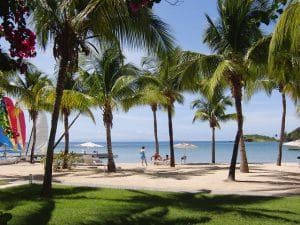
Grand Anse is Grenada’s crown jewel and one of the Caribbean’s most celebrated beaches — a two-mile crescent of fine white sand on the island’s south-west coast, with calm, clear water, a gently sloping seabed that makes it safe for all abilities and a backdrop of green hills and local wooden fishing boats that gives it a postcard perfection that is entirely natural rather than manufactured.
The beach is lined on its landward side with a low-rise strip of hotels and restaurants that is well-developed but not overwhelming in scale — nothing here feels as densely built as the resort towns of the Dominican Republic or Jamaica. Sun loungers and watersports hire are available from the beach operators; several good restaurants and beach bars serve the full length of the beach throughout the day and evening.
Snorkelling off the southern end of Grand Anse reveals healthy coral and the excellent marine life that characterises Grenadian waters. Morne Rouge Bay (locally called BBC Beach), a quieter and smaller cove just south of Grand Anse, is an excellent alternative for those wanting more seclusion — the snorkelling here is particularly good and the atmosphere is noticeably calmer than the main beach.
Grenada produces approximately 20% of the world’s nutmeg supply and the spice — along with mace, cinnamon, cloves, turmeric, ginger and cocoa — defines the island’s agricultural landscape and cultural identity. Visiting a spice plantation in the Grenadian interior — watching nutmeg being split to reveal the red mace around the inner seed, breathing the extraordinary fragrance of drying spices in the estate buildings — is one of the most sensory and memorable experiences available in the Caribbean.
Grenada also produces what many connoisseurs consider the finest chocolate in the Caribbean. The Grenada Chocolate Company and Belmont Estate both operate bean-to-bar chocolate production using the exceptional Trinitario cocoa grown on the island’s volcanic soils. Tours of both operations are available and the quality of the finished chocolate — single origin, carefully fermented and roasted — is genuinely outstanding by any international standard.
The island’s interior nature offers rewarding hiking to Seven Sisters Waterfalls, swimming in Grand Étang Lake (a crater lake at 530 metres in the centre of the island, surrounded by cloud forest) and encounters with Grenada’s extraordinary birdlife — including the critically endangered Grenada dove, found only on this island.
The waters around Grenada offer some of the finest diving in the eastern Caribbean. The Underwater Sculpture Park off the coast near the capital St. George’s is one of the world’s most remarkable dive sites — over 65 life-size sculptures created by British artist Jason deCaires Taylor, installed at depths of 5–8 metres, now encrusted with coral and inhabited by marine life in a way that turns them into genuine artificial reef habitats. The sculptures include a circle of figures holding hands, a writer at a desk and a reclining woman reading — all now part of the reef ecosystem.
The Bianca C — a 183-metre Italian ocean liner that sank in Grenada’s harbour in 1961 and is now one of the Caribbean’s most celebrated wreck dives — lies at 29–50 metres and hosts an extraordinary community of marine life including giant turtles, nurse sharks and schools of barracuda. The wreck is sometimes called the Titanic of the Caribbean and is on the bucket list of serious divers worldwide.
Snorkelling is excellent across many of the island’s protected bays and around the offshore island of Carriacou — Grenada’s larger sister island, 35 kilometres north and accessible by ferry, with pristine coral reefs, excellent beaches and a character even more unspoiled than Grenada itself.
Grenadian food reflects the island’s extraordinary spice heritage — the cooking here is more richly spiced than elsewhere in the anglophone Caribbean and the results are some of the most flavoursome meals available in the region. The national dish is oil down — a one-pot stew of breadfruit, salted meat, coconut milk and dasheen leaves seasoned with turmeric, saffron and the island’s own spices, slow-cooked until the coconut oil is absorbed and a golden crust forms at the bottom of the pot. It is deeply satisfying and utterly Grenadian.
Fresh seafood is excellent — the fishing boats that share Grand Anse beach with the sunbathers land their catch each morning and the restaurants that line the beach serve genuinely fresh fish throughout the day. The spiced rum punch of Grenada — made with the locally produced River Antoine Rum (one of the few pot-still rums made using traditional waterwheel-powered methods) and flavoured with nutmeg — is the defining drink of the island and one of the finest versions of the Caribbean standard.
The Grenadian chocolate experience should extend beyond the factory tours to the chocolate bars, chocolate drinks and chocolate desserts available throughout the island. The quality of Grenada’s bean-to-bar chocolate is such that visiting chefs and food writers regularly single it out as among the finest in the world.
Maurice Bishop International Airport in the south of the island receives direct charter and scheduled flights from UK airports, with the greatest frequency during the winter season. British Airways flies from Gatwick seasonally; charter operators including TUI provide additional capacity during the peak winter months. Flight time from London is approximately nine hours.
Taxis operate island-wide from the airport, with fixed rates to the main hotel areas. Minibuses provide cheap public transport along the main coastal roads. Car hire gives the most freedom for exploring the interior — Grenada’s roads are good by Caribbean standards and the island is small enough that hiring a car for just two or three days of interior exploration is a practical and rewarding option.
Search4Sun works with leading UK tour operators to find the best value Grenada holidays, with flights and hotel packages from local airports across the UK. For peace of mind when booking, always check your holiday is ABTA protected.
For last-minute Grenada deals, check LastMinute.com for the latest rates. Also see our guide to Caribbean holidays for the full regional overview.
Grenada earned the name Spice Island because it produces approximately 20% of the world’s nutmeg supply — making it the second-largest nutmeg producer globally after Indonesia. The island also grows mace, cinnamon, cloves, turmeric, ginger and high-quality cocoa, and the spice economy has shaped Grenadian agriculture, cuisine and culture for over 300 years.
The nutmeg appears on the Grenadian flag — a red background with the image of a nutmeg pod on the left stripe — reflecting how central the spice is to the island’s identity. The scent of drying spices is detectable across much of the island interior and is one of Grenada’s most distinctive sensory experiences.
Grenada is one of the Caribbean’s finest diving destinations. The Underwater Sculpture Park — over 65 life-size sculptures now forming an artificial reef — is unique in the Caribbean and one of the most photographed dive sites in the world. The Bianca C wreck is on every serious diver’s bucket list.
The waters around Grenada and nearby Carriacou have excellent visibility, healthy coral reefs and diverse marine life including turtles, rays and numerous shark species. Dive operators are available throughout the island with very reasonable rates compared to better-known Caribbean dive destinations.
January to April is the dry season and the best time for beaches and outdoor activities — clear skies, low humidity and warm temperatures (26–30°C). December and January are the peak months, with the highest prices and most visitors.
Grenada sits below the main hurricane belt and is less vulnerable than more northerly islands during the June to November hurricane season. The summer months offer good value and the interior landscape is at its most lush and green. The Grenada Sailing Festival in January and the Carnival in August are two of the island’s major annual events.
Carriacou, Grenada’s larger sister island, is accessible by ferry from the Carenage in St. George’s — the journey takes approximately 90 minutes and ferries operate several times daily. A small propeller aircraft also connects the two islands in about 20 minutes if you prefer the faster and more expensive option.
Carriacou is well worth the trip — the island has pristine beaches, excellent snorkelling, a strong boatbuilding tradition and an even more relaxed atmosphere than Grenada itself. A day trip is feasible; an overnight or two-night stay allows a more thorough exploration of this unspoiled gem.
If you book a flight-inclusive Grenada package through a UK ATOL-licensed tour operator, yes. Your money and repatriation are covered if the operator fails. Booking flights and accommodation independently removes that protection. Our holiday protection guide covers ATOL, ABTA and Section 75 in full.
All packages listed on Search4Sun are offered by ATOL-licensed UK tour operators, so you can compare and book with confidence.
Most popular full-day tours


Visa requirements vary significantly by nationality. We recommend contacting your local embassy or immigration office for accurate and up-to-date information.
Check requirements at IATA Travel Centre →| Month | Avg Temp (°C) | Avg Rainfall (mm) |
|---|---|---|
| Jan | 24.9°C | 86.7 mm |
| Feb | 24.9°C | 58.3 mm |
| Mar | 25.2°C | 80.8 mm |
| Apr | 25.8°C | 67 mm |
| May | 26.4°C | 87.5 mm |
| Jun | 26.1°C | 145.6 mm |
| Jul | 26.1°C | 169.2 mm |
| Aug | 26.5°C | 118.9 mm |
| Sep | 27.1°C | 70 mm |
| Oct | 27°C | 118.4 mm |
| Nov | 26.2°C | 122.7 mm |
| Dec | 25.4°C | 92.4 mm |
Search4Sun has been comparing UK holiday packages since 2005. We work with some of the best ABTA-registered operators.