HomeDestinationSpainCosta Tropical
Last updated: October 2026
Costa Tropical holidays offer Granada province’s best-kept secret — a sheltered 80-kilometre Mediterranean coastline with a unique microclimate warm enough to grow tropical fruits, dramatic cliff scenery, excellent diving and the kind of unhurried Andalusian authenticity that has largely disappeared from the more commercial Spanish coasts. Within 70 kilometres of the Alhambra and within a day’s drive of the Sierra Nevada ski slopes, the Tropical Coast combines beaches, culture and mountain landscapes in a combination found nowhere else in Europe.
The Costa Tropical has three distinct bases — the main resort town of Almuñécar, the small diving village of La Herradura, and the working port town of Motril. Each has a different character and suits different types of traveller.
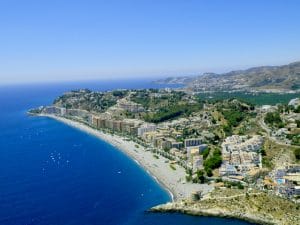
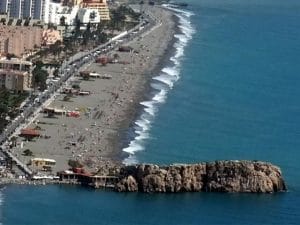
Almuñécar holidays offer the most complete Costa Tropical experience. This ancient town — with Phoenician and Roman foundations — sits above two beaches divided by the dramatic Peñón del Santo rock formation. The Castillo de San Miguel Moorish fortress dominates the hilltop above the old quarter.
Almuñécar has a genuine working-town feel alongside its tourist infrastructure — a covered food market, a university campus and a resident population that gives the evening promenade and tapas bars a thoroughly Spanish character. It suits couples and independent travellers who want authentic Andalusia at the coast.
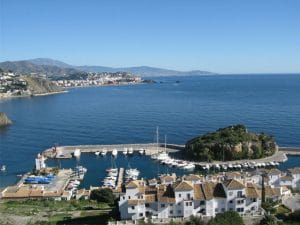
La Herradura holidays attract those who have discovered one of the most beautiful and undisturbed bays on the Spanish Mediterranean. Named for the perfect horseshoe curve of its sheltered bay, La Herradura has an almost completely natural beach backed by a low-key promenade of restaurants and small hotels.
The bay’s calm, clear water and the rocky reef immediately offshore make it one of the best diving and snorkelling locations on the Spanish Mediterranean. It is a 10-minute drive west of Almuñécar and completely different in character — quieter, smaller and more focused on the sea itself.
Salobreña holidays combine one of the most dramatic sights on the coast — a whitewashed Moorish castle town rising on a rocky hill from a flat sugar cane plain — with a good sandy beach directly below. The old town is authentically Andalusian with steep streets, a well-preserved castle and outstanding views in all directions.
Salobreña’s beach resort area sits 2 kilometres from the old town. The combination of dramatic townscape and good beaches makes it one of the most photogenic bases on the Costa Tropical.
Motril holidays suit those wanting the largest town on the Costa Tropical as a base. This is principally a commercial and agricultural centre — Spain’s most northerly tropical fruit growing area is here — but has a good beach at Playa de Poniente, a small cruise port and an authentic market-town atmosphere. It is the best-connected town on the coast for public transport.
The Costa Tropical’s microclimate is exceptional. Sheltered from northerly winds by the Sierra Nevada and Sierra de Almijara mountain ranges, and facing south and southeast into the Mediterranean, the coast is warmer in winter and marginally cooler in summer than the Costa del Sol to the west.
Winter temperatures average 17–19°C — warm enough for comfortable walking and outdoor dining year-round. Frost is virtually unknown on the coast. This climate is what makes the cultivation of tropical fruits — avocados, mangoes, custard apples and limes — possible this far north.
Sea temperatures reach 24–25°C in August and remain at 20–21°C well into October. The beaches at Almuñécar tend to be dark sand and shingle rather than the fine pale sand of the Costa del Sol — common to much of the Granada coast. La Herradura’s bay has fine gravel and excellent clarity.
Most Costa Tropical beaches carry Blue Flag status. Lifeguards operate on all main beaches from June to September. The beaches are noticeably less crowded than the Costa del Sol — even in August, the coast retains a far more relaxed atmosphere.
La Herradura is the diving hub of the Costa Tropical and one of the best diving locations on the Spanish Mediterranean. The bay’s rocky reef — the Punta de la Mona headland — drops away sharply into clear, calm water with excellent marine biodiversity.
Several PADI dive centres operate from La Herradura year-round. The protected bay and calm conditions make it excellent for beginners. More advanced divers explore the reef walls, sea grass beds and the occasional octopus and moray eel habitats. Visibility regularly exceeds 20 metres in calm conditions.
Windsurfing and kitesurfing conditions vary considerably. The Levante wind from the east can produce good conditions on the eastern beaches near Motril. La Herradura’s sheltered bay is calmer and better for kayaking, paddleboarding and swimming.
Walking in the Parque Natural de Sierra de Almijara, Alhama y Tejeda — the mountain range immediately behind the coast — is outstanding. The trails from La Herradura up to Cerro Gordo and along the coastal cliffs give extraordinary views over the Mediterranean. Spring wildflowers and bird life make April and May particularly rewarding months for walking.
Sea fishing trips, boat excursions along the dramatic cliff coastline east towards Almería and horse riding on the beaches near Motril and Almuñécar are all available from local operators.
The Costa Tropical has a deeper historical heritage than most beach coasts. Almuñécar was founded by the Phoenicians as Sex or Sexi — one of the earliest permanent settlements on the Iberian Peninsula. The Roman fish-salting factory (garum) beneath the Castillo de San Miguel is still visible and there is a significant Roman archaeological zone in the town centre.
The Castillo de San Miguel, rebuilt by the Moors in the 10th century on earlier foundations, is one of the best-preserved fortresses on the Granada coast and houses a small museum with Phoenician, Roman and Moorish artefacts.
Salobreña’s Moorish castle is equally impressive — the last refuge of Boabdil before the fall of Granada in 1492. The view from the castle walls across the Mediterranean and back to the snow-capped Sierra Nevada is one of the finest panoramas on the Andalusian coast.
The Costa Tropical’s unique tropical fruit growing culture adds an unusual ingredient to the local food scene. Avocado, mango and chirimoya (custard apple) appear in local markets, restaurants and even ice creams throughout the coast. The annual chirimoya and mango festivals in October are celebrated with considerable local pride.
Seafood is outstanding — the anchovies from Motril and Almuñécar are among the best on the Mediterranean coast, often served simply grilled with olive oil. Local restaurants serve fresh fish caught daily from the small fishing fleet that still operates from several Costa Tropical ports.
Almuñécar’s old town has a good concentration of tapas bars and restaurants in the streets around the market and castle. The Thursday and Sunday markets are excellent for local produce. The wider Granada province wine culture — particularly the Contraviesa-Alpujarra and Órgiva areas — produces interesting local wines to accompany the coastal cooking.
The Costa Tropical’s position below the Sierra Nevada puts some of Andalusia’s greatest sights within close reach.
Granada and the Alhambra — 70 kilometres north via the A-44 motorway — is the most popular and most rewarding excursion. The Nasrid Palaces are among the greatest architectural achievements in history. Allow 60–75 minutes each way and book timed entry tickets weeks in advance in summer as they sell out consistently.
Sierra Nevada is 90 kilometres north of Almuñécar — the Pradollano ski station is accessible from the coast in under 2 hours. In winter months (December–April), skiing in the morning and swimming in the sea in the afternoon is theoretically possible on the same day. In summer, the high peaks are excellent for walking.
The Alpujarras — the high mountain villages on the southern face of the Sierra Nevada — are 50–60 kilometres from the coast. Lanjarón, Órgiva and the high Poqueira valley villages of Capileira, Bubión and Pampaneira are extraordinarily beautiful and completely different in character from the coast.
Nerja and the Costa del Sol lie 30–40 kilometres west — the Nerja Caves, the Balcón de Europa viewpoint and the excellent beaches at Burriana are easy half-day excursions. Coastal Road East towards Almería offers some of the most dramatic cliff scenery on the Spanish Mediterranean — worth a scenic drive even without a specific destination.
Málaga-Costa del Sol Airport (AGP) is the main gateway — it handles direct flights from over 30 UK airports year-round and transfer time to Almuñécar is 90–100 minutes via the A-7 coastal road. Most UK tour operators use Málaga as the access point for Costa Tropical packages.
Granada Airport (GRX) is closer — just 55–60 kilometres from Almuñécar — but has very limited direct UK flights. Iberia and Vueling connect Granada to Madrid and Barcelona. Worth checking if combined flights work out cheaper or more convenient from your local airport.
Transfer times from Málaga Airport: Almuñécar 90 minutes; La Herradura 95 minutes; Salobreña 100 minutes; Motril 110 minutes. The coast road is scenic but can be slow in summer — the A-7 motorway is faster where available.
Car hire is strongly recommended. The coast road between resorts is easy to drive but the best day trips — Alhambra, Alpujarras, Sierra Nevada — require flexibility that only a hire car provides. Car hire at Málaga Airport is plentiful and well priced, especially when booked in advance.
| Airport | Málaga (AGP) · Granada (GRX) |
|---|---|
| Flight time from London | Approx. 2 hrs 40 mins (Málaga) |
| Coastline | 80 kilometres in Granada province |
| Best for | Couples, diving, culture, walking, authentic Spain |
| Peak season | June–September (year-round for mild weather) |
| Currency | Euro (EUR) |
| Language | Spanish (limited English outside main tourist areas) |
| Top bases | Almuñécar, La Herradura, Salobreña, Motril |
| Must-do | Granada Alhambra, La Herradura diving, Salobreña castle, Alpujarras |
| Unique feature | Tropical fruit growing coast — the only one in mainland Europe |
Search4Sun works with leading UK tour operators to find the best value Costa Tropical holidays. Browse departures from local airports across the UK. For peace of mind when booking, always check your holiday is ABTA protected.
For last-minute Costa Tropical deals, check LastMinute.com for the latest availability and rates.
The Costa Tropical is unique in mainland Europe for its microclimate — sheltered by the Sierra Nevada, it is warm enough to grow tropical fruits (avocados, mangoes, custard apples) at sea level. This same climate produces mild winters and pleasantly warm rather than scorching summers compared to the Costa del Sol.
The coast is less developed than its neighbours — it has no large purpose-built resorts and retains an authentically Andalusian character. It is also one of the best-positioned coasts in Spain for day trips — the Alhambra, Sierra Nevada and Alpujarras are all within 90 minutes.
La Herradura bay is ideal for families with young children — the sheltered horseshoe bay has calm, shallow water and no surf. Almuñécar has family-friendly beaches and a range of hotels and apartments. The coast suits families who want authentic Spain rather than big resort facilities.
It is not the right choice for families expecting kids’ clubs, water parks and nightly entertainment. For that, the Costa del Sol resorts at Fuengirola or Benalmadena are a better fit. But families who enjoy snorkelling, walking and exploring will find the Costa Tropical outstanding.
Granada city and the Alhambra are 70–75 kilometres from Almuñécar — around 60–75 minutes by car via the A-44 motorway through the mountains. A hire car is the most practical way to visit. Buses run from Motril to Granada city but are slower.
Book Alhambra tickets as early as possible — they sell out weeks ahead in summer. The Nasrid Palaces require a separate timed ticket from the gardens. The full Alhambra visit takes 3–4 hours; allow a full day for Granada including the Albaicín quarter and cathedral.
Costa Tropical beaches are mainly dark sand and fine gravel rather than pale sand — typical of the Granada and eastern Málaga coast. The water is exceptionally clear. La Herradura’s sheltered bay is the finest beach on the coast — calm, scenic and excellent for snorkelling.
Almuñécar has two main beaches divided by the Peñón del Santo rock — Playa San Cristóbal and Playa de la Caletilla. Salobreña has a good sandy beach directly below the old town. None of the Costa Tropical beaches are as long or as developed as the big Costa del Sol resort beaches, but they are considerably less crowded.

Visa requirements vary significantly by nationality. We recommend contacting your local embassy or immigration office for accurate and up-to-date information.
Check requirements at IATA Travel Centre →| Month | Avg Temp (°C) | Avg Rainfall (mm) |
|---|---|---|
| Jan | 13°C | 42.5 mm |
| Feb | 14.2°C | 27.7 mm |
| Mar | 15.7°C | 130.1 mm |
| Apr | 18°C | 42.3 mm |
| May | 21.3°C | 35.4 mm |
| Jun | 25.8°C | 19.4 mm |
| Jul | 28.8°C | 0.9 mm |
| Aug | 28.8°C | 3.1 mm |
| Sep | 24.8°C | 31.2 mm |
| Oct | 21.6°C | 37.3 mm |
| Nov | 16.9°C | 28.2 mm |
| Dec | 14°C | 61.8 mm |
Search4Sun has been comparing UK holiday packages since 2005. We work with some of the best ABTA-registered operators.